Guide ·
How to Get Voices for NPCs in Your Game: 5 Ways Compared
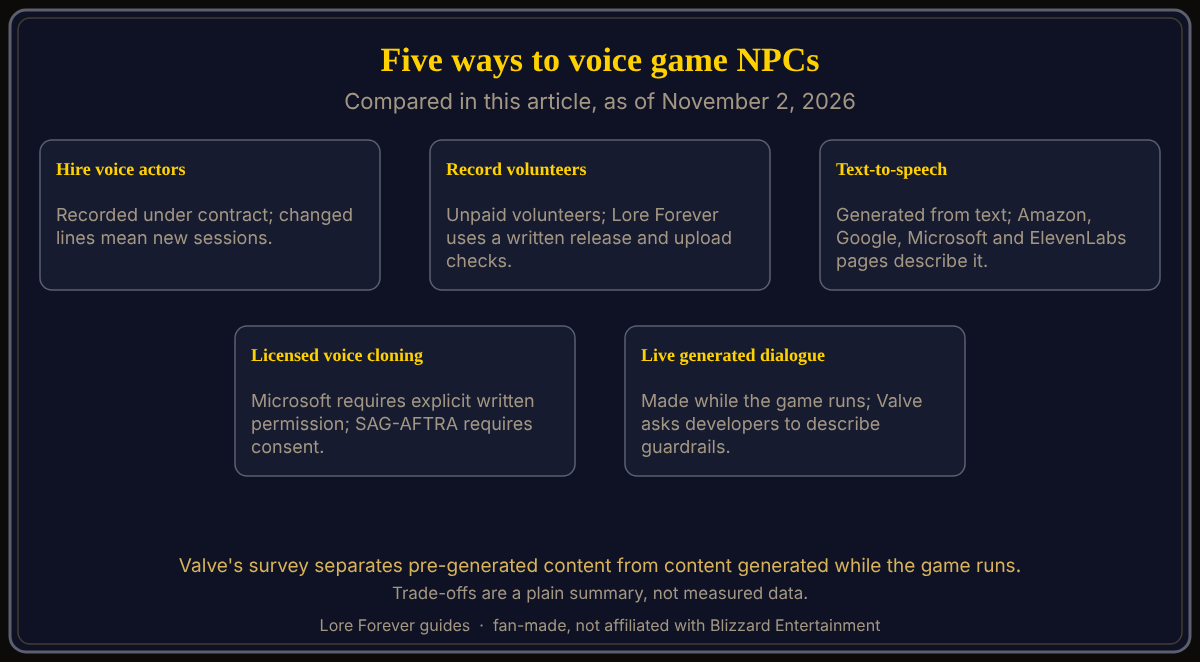
You can get voices for the NPCs in your game in five main ways: hire voice actors, record volunteers, use text-to-speech or other AI voices, license a cloned voice with the performer's consent, or generate dialogue while the game runs. You can mix them; each trades cost, quality, consistency, consent and file size differently.
Quick answer: Pre-recorded files, from volunteers or generated voices, are what Lore Forever ships. Cloned and live-generated voices raise consent and moderation questions: SAG-AFTRA's 2025 agreement covers digital-replica consent, and Valve's Steam survey asks about live-generated content.
Key facts
- SAG-AFTRA: members approved its 2025 Interactive Media Agreement on July 9, 2025, with 95.04% in favor (SAG-AFTRA)
- Consent: the agreement has "consent and disclosure requirements for A.I. digital replica use" (SAG-AFTRA)
- Microsoft: custom neural voice is a Limited Access feature; customers must warrant that they have explicit written permission from voice talent (Microsoft Learn)
- Valve: its Steamworks survey separates pre-generated from live-generated AI content and asks for guardrails on live-generated content (Steamworks)
- Case study (ours): Lore Forever ships recorded narration in a WoW add-on, with no text-to-speech at play time (Lore Forever FAQ)
What are the main ways to voice game characters?
- Hire voice actors. You get a performance under a contract; changed lines mean new sessions.
- Record volunteers. Free to you, uneven in quality, and dependent on written releases.
- Text-to-speech. Fast to redo when text changes; voices can sound generic.
- Licensed voice cloning. A consenting performer's voice used for lines they never read.
- Live generation. Characters answer whatever the player says; hardest to control.
These trade-offs are our summary, not measured data.
What do text-to-speech services offer, per their own pages?
Pages read November 2, 2026. AWS calls Amazon Polly "a cloud service that converts text into lifelike speech", lists games among uses, and says generated speech can be cached and replayed at no additional cost. Google's Chirp 3: HD page lists 30 voices and 53 locales, and labels its SSML support Preview and not supported for streaming requests. Microsoft's Azure Speech page describes neural voices, SSML to adjust pitch, pronunciation and speaking rate, and private custom voices. ElevenLabs' page says it offers thousands of voices across 32 languages, with instant and professional cloning. Voice quality, speed and prices are not compared here.
What do consent rules say about cloned voices?
Microsoft's Limited Access page says custom neural voice is available by registration only, and that customers must warrant they have explicit written permission from voice talent. SAG-AFTRA's contract FAQ says the employer must give a "reasonably specific description of intended use", which includes whether the character will be used for real-time generated dialogue, and that consent is invalidated if the use no longer fits it. Davis+Gilbert's November 2025 summary adds that consent is written and required for digital replicas and for real-time generation, with minimum rates for both. UK Equity statements were not opened for this article.
Can characters talk back live?
Convai's Unity page describes "intelligent NPCs" for games. Inworld's docs describe a realtime voice API; a February 2023 Unreal Marketplace listing says players can speak to its characters or type. For any live system, Valve's Steamworks survey asks developers to describe the guardrails on content generated while the game runs, and does not name voice.
How did Lore Forever voice a WoW add-on?
This is our own project, so weigh it accordingly. The Lore Forever add-on narrates lore for World of Warcraft: Forever. Per its FAQ, the included male narrator and the optional female narrator are generated voices, not voice actors, tuned until names and places sound right. Every narration is a recorded file, so playback never uses your system's text-to-speech. Volunteers record too: the narrator guide gives a clip list with the exact text and recording settings, and the narrator release makes it unpaid volunteer work, for adults only, under CC BY-SA 4.0. A voice without a recording for a story hands it to the next voice in the player's order. The cost is size: as of November 2 the downloads are 315 MB, 1.6 GB and 2.9 GB. See narrator voices explained and quest voice add-ons.
How do characters answer in Willo?
Willo is a companion app next to the game. Her page says characters you target answer in their own voices, with a dwarf, an orc, a night elf and a tauren shown, and her plans page lists character voices under the paid plans. Her privacy page says reply text goes to an outside voice service and that "We don't keep the words". She can be wrong. See the Willo companion guide.
What is not confirmed yet
- Voice quality, latency in a real game and prices: not tested or compared here.
- The Inworld and Convai pages opened here do not mention voice rights.
Frequently asked questions
How do I get voices for NPCs in my game?
Choose among actors, volunteers, text-to-speech, licensed clones and live generation; cloning and live generation raise the consent questions.
Do I need permission to clone a voice for a game?
Microsoft's Limited Access page requires customers to warrant explicit written permission from voice talent. Per Davis+Gilbert's summary, SAG-AFTRA's 2025 agreement requires written, reasonably specific consent for digital replicas.
Can I use text-to-speech for game NPCs?
Yes. Amazon Polly, Google Cloud, Azure Speech and ElevenLabs each describe text-to-speech services. Check each page for current terms and prices.
Does Steam require disclosure of AI voices?
Valve's Steamworks Content Survey covers AI-made content that ships with a game and that players consume, such as artwork, sound and narrative, and asks for guardrails on live-generated content. It does not name voice.
Can volunteers voice my game?
Yes. Lore Forever uses a written narrator release, a clip list and checks on upload; the recordings are unpaid and released under CC BY-SA 4.0.
Sources
Reviewed November 2, 2026. Third-party claims come only from the cited official pages. Lore Forever and Willo are fan-made and are not affiliated with Blizzard Entertainment.
- SAG-AFTRA members approve 2025 agreement and contract page
- SAG-AFTRA's new video game agreement (Davis+Gilbert)
- Microsoft: Limited Access for text to speech and Azure Speech overview
- What is Amazon Polly (AWS)
- Chirp 3: HD voices (Google Cloud)
- Text to speech (ElevenLabs)
- Convai Unity plugin, Inworld docs and Inworld Unreal Marketplace listing
- Steamworks Content Survey (Valve)
- Lore Forever FAQ, narrator guide, narrator release and downloads
- Willo and Willo privacy